
Deck repair or replacement in Franklin and Spring Hill, TN: how to tell which you need
By Nixon Renovations LLC · Spring Hill, TN · Updated October 31, 2026
Deck repair or replace comes down to what’s failing. If the problems sit on top (worn boards, a wobbly railing, a couple of soft joists), repair is usually enough. If the beams, posts, footings or the ledger bolted to your house are rotted or loose, or the deck was never permitted, replacement is the safer call. The 8-step check below shows you where to look on a Franklin or Spring Hill deck.
Nixon Renovations has built and repaired decks around Franklin, Spring Hill, Columbia and Thompsons Station since 2002. This guide walks you through the same checks we make on a visit, using guidance from NADRA (the North American Deck and Railing Association) and the deck rules published by the City of Franklin and the City of Spring Hill.
What’s the difference between deck repair and deck replacement?
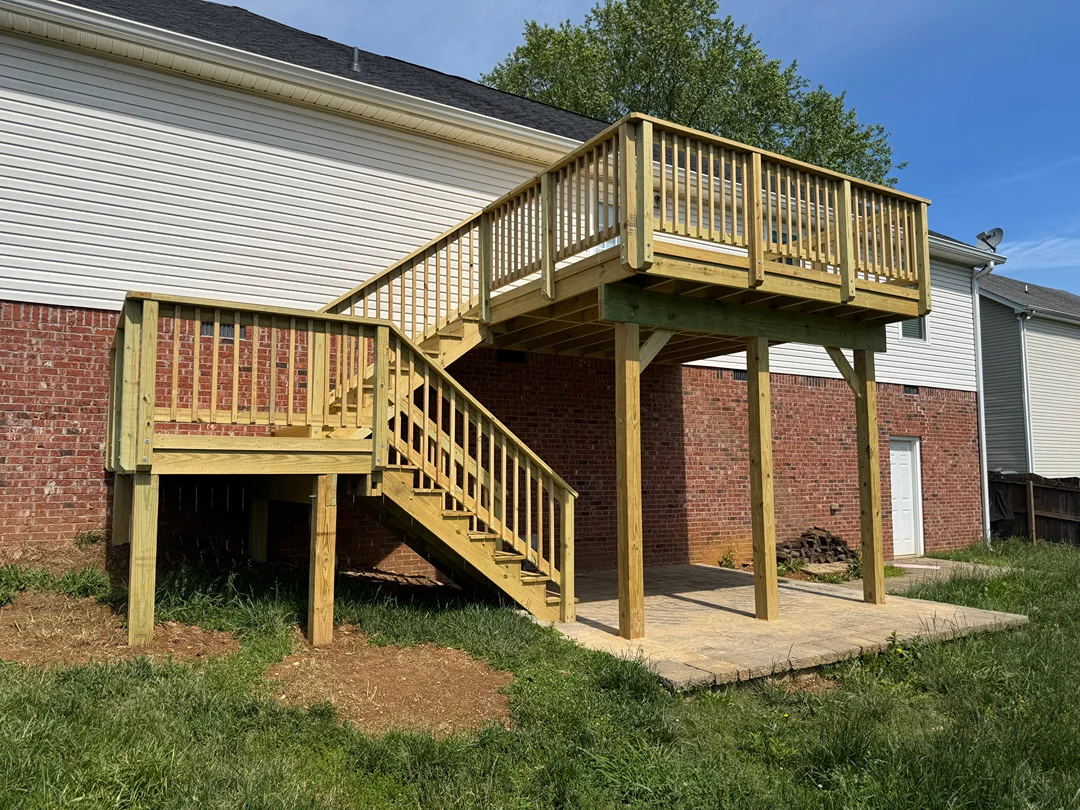
Repair keeps the deck’s frame and fixes the parts that wear out: surface boards, railings, stair treads, a few joists or loose hardware. Replacement means tearing the deck down to the ground and building a new frame, ledger connection and footings. The condition of the structure underneath decides which one you need.
A deck has two layers. The top layer (boards, railings, balusters, stair treads) is meant to be swapped out over the deck’s life. The bottom layer is the frame: joists, beams, posts, footings and the ledger board that ties the deck to your house. When the frame is sound, almost anything on top can be repaired. When it isn’t, new boards on a bad frame only hide the problem.
Our deck services cover both. Deck repair and restoration includes board replacement, refinishing and railing upgrades. Full replacement runs through our deck installation process, with permits and inspections handled for you.
How old is too old for a deck in Middle Tennessee?
There’s no fixed age, but older decks need a closer look. NADRA estimates 40 million residential decks in the US are more than 20 to 30 years old, and it recommends checking every deck once a year. Older decks were often built with connections that today’s rules no longer accept.
NADRA has run Deck Safety Month every May since 2006, with a free 10-point “Check Your Deck” checklist for homeowners. May comes right before cookout season here, a good time to find a loose stair.
Age matters most at the ledger. NADRA notes that some older decks are attached to the house with nails only, instead of the lateral tension hardware used today. A nailed ledger can look fine from the yard for years. If your Franklin or Spring Hill home came with a deck and you don’t know who built it or when, treat it as an older deck until someone has checked the ledger.
How do I check my deck for signs it’s unsafe?
Start on top, then go underneath with a flashlight and a screwdriver. Press the screwdriver into the wood at the ledger, joists, posts and stair stringers. Wood that’s soft, spongy or flakes away in strings is a warning sign. Then test the railings, stairs and overall wobble by hand.
Here’s the checklist we use on a repair visit, in the order we walk it:
- Walk every deck board and look for soft spots, deep splits, cupping and popped nails or screws.
- Get under the deck and probe the joists and beams, especially where water sits on top of them.
- Check the ledger where the deck meets the house: what it’s fastened with, whether it’s flashed, and whether it’s attached to brick veneer.
- Look at each post and footing for rot at the base, posts sitting in soil, or concrete that has cracked or settled.
- Push on every railing and guard post, and check the gaps between balusters with a 4-inch object.
- Walk the stairs, look at the stringers, and check the opening behind open treads.
- Look at nails, screws, bolts, hangers and brackets for rust, missing pieces and loose connections.
- Stand in the middle of the deck and shift your weight side to side to feel for sway.
Problems on steps 1, 5 or 6 are often repairs. Problems on steps 2, 3, 4 or 8 point at the frame, and that’s where replacement comes up.
1. Deck boards
Surface boards take the most weather, and unsealed wood grays, splits and holds water. Push a screwdriver into any dark spot. If it sinks in, the board is rotting. A handful of bad boards on a solid frame is a normal repair. If most boards are failing, check the joists before you price new decking.
2. Joists and beams
Joists run under the boards, and beams carry the joists to the posts. Look at the tops of the joists between boards, where water and leaves collect, and probe the joist ends. One or two soft joists can often be replaced or doubled with new lumber. Rot across many joists, or a sagging or split beam, is a frame problem.
3. The ledger
The ledger is the board fastened to your house that holds one side of the deck. Look for nails with no bolts, missing flashing, water stains on the house framing, and any gap between the ledger and the wall. Then check what it’s attached to. The City of Franklin’s deck handout says a deck cannot be fastened to brick veneer. It has to attach to the structural parts of the house.
4. Posts and footings
Rot usually starts where a post meets soil or concrete. Posts buried in dirt, posts that have shifted off their footings, and cracked or sunken concrete are all warning signs. For new decks, Franklin’s handout calls for footings at least 16 by 16 inches with at least 8 inches of concrete under the posts, dug to undisturbed soil, and the city inspects pier holes before concrete is poured. You can’t see an old footing’s size from above ground.
5. Railings and the 4-inch rule
Push hard on each railing post. It shouldn’t move. Both cities use a 4-inch sphere rule between spindles, and guards are required where the deck is more than 30 inches above grade. Franklin’s handout lists a 36-inch minimum guard height, while Spring Hill’s checklist shows guards not less than 42 inches high, so a railing built to one city’s number may not pass in the other. Loose or short railings are usually a railing upgrade, as long as the frame is solid.
6. Stairs and the 4-inch opening
Probe the stringers (the angled boards that hold the treads) and the bottom of the stairs where they meet the ground. NADRA says the opening behind open stair treads should be no more than 4 inches. Franklin’s handout sets rise at no more than 7 3/4 inches, treads at least 10 inches, nosing no more than 1 1/4 inches, all steps uniform, and a graspable handrail 34 to 38 inches above the nosing when there are more than 3 risers. Uneven steps or a missing handrail can usually be rebuilt on their own.
7. Fasteners and corrosion
Look at nails, screws, bolts, joist hangers and post brackets. Rust streaks, hangers missing nails, flaking metal and bolts you can turn by hand mean the connection is weakening. Corroded hangers or ledger bolts hold the frame together and need attention right away.
8. The wobble test
Shift your weight side to side near the middle and the outer edge. Sway can come from loose post connections, missing bracing or a ledger that’s letting go. Added bracing and new hardware fix some of it. If the sway comes from the ledger or rotted posts, you’re looking at replacement.
When does deck repair make sense?
Repair makes sense when the frame, ledger and footings are sound and the damage is limited to parts that wear out. That means replacing surface boards, swapping a few joists, rebuilding a set of stairs, or upgrading railings to current height and spacing rules. Refinishing an older wood deck falls here too.
A typical repair: the frame checks out, so we pull split boards, replace any soft joists, and lay new decking in pressure-treated pine, cedar or composite. Or the deck is fine but the baluster gaps are too wide, so we rebuild the railing to the 4-inch rule. One customer wrote:
“We have had Nixon Renovations do excellent work on our home including deck repairs as well as replacing water damaged trim. Without reservation we commend this company to you for excellent work and craftsmanship.”
S Garrett, Google review
After a repair, reseal wood decks every 2 to 3 years and wash composite with soap and water. If you’re picking new boards, our post on composite vs wood decking in Middle Tennessee compares them.
Not sure which side your deck falls on? Request a free estimate or call 931-616-1524. We’ll walk the deck with you and give you a written quote for deck repair in Franklin, TN, Spring Hill or anywhere in our service areas.
When should you replace a deck instead of repairing it?
Replace the deck when the parts that carry the load have failed or can’t be trusted. Rotted beams and posts, a ledger held by nails or fastened to brick veneer, damaged footings, and decks built without a permit all fall here. Replacement also makes sense when you want a different size or layout.
With rotted framing, you’d be paying to replace most of the frame anyway, and the old ledger and footings would stay behind. With a failed ledger, fixing it means removing the boards and joists on that side to reach it. With an unpermitted deck, nobody inspected the footings or pier holes, and you can’t see either from the yard. A permitted replacement gets those inspected in the open.
The last reason isn’t damage. The old deck may be too small for your table, the stairs may land in the wrong spot, or you may want a roof. When the old frame won’t support the new plan, a custom deck built from scratch is simpler.
“John, rebuilt our old worn out deck. The design, craftsmanship, and materials used were excellent.”
Thomas Smith, Google review
| What you find | Usually repair | Usually replace |
|---|---|---|
| Deck boards | Some boards split or soft; frame is solid | Most boards failing and joists soft too |
| Joists and beams | One or two soft joists | Rot across many joists, or a split or sagging beam |
| Ledger | Bolted, flashed and dry | Nails only, pulling away, or fastened to brick veneer |
| Posts and footings | Posts sound, footings intact | Rotted post bases, posts in soil, sunken footings |
| Railings and stairs | Loose, short or wide gaps on a solid frame | Failure tied to a rotted frame or footing |
| Permit history | Permitted and inspected | No permit, footings never inspected |
| Your plans | Happy with size and layout | Want a bigger deck, new shape or a roof |
Does a deck replacement in Spring Hill, TN need a permit?
Yes. A replacement is a new deck to the permit office, even in the same spot. Spring Hill asks for a plot plan and construction drawings, and Franklin requires a building permit before any work starts. Nixon Renovations handles the permits, inspections and approvals on every deck we build, so you don’t have to.
Spring Hill’s Development Services checklist wants a plot plan with the deck’s location and size, setbacks, easements, other structures and any septic tank. The drawings show footing size and depth, joist size and spacing, post and beam sizes and connections, the ledger attachment with flashing, handrail height and stair location. A hot tub or swim spa on the deck requires engineering.
Inside Columbia city limits, permits go through City of Columbia Development Services. Unincorporated areas go through Maury County Building and Zoning or Williamson County Building and Codes. Our guide to deck permits in Franklin, Spring Hill and Columbia has the details, and our Maury County deck builder page covers the area south of Spring Hill.
Can I reuse my old deck’s footprint?
Usually, yes, and it’s often the simplest path. Keeping the same size and position means your doors, stairs and yard already line up. What you can’t reuse is anything below current standards. The footings, ledger, railings and stairs get built new to today’s rules, and the work still goes through a permit.
We tear the old deck down to the ground and dig new footings to the size the permit office requires and to undisturbed soil, with the city inspecting the holes before concrete. The ledger goes on the structural framing with flashing, not on brick veneer. Railings go in at the height your city uses. If you want to grow the deck, the plot plan shows the new size and setbacks, and a roof brings Franklin’s setback rules into play.
How much does deck repair or replacement cost in Williamson County?
It depends on how much of the deck is failing, its size, the materials and how easy the site is to reach. A board and railing repair costs far less than a rebuild. For full replacement, the Cost vs Value 2025 report gives national figures for a 320-square-foot deck that make a fair starting point.
The report from Zonda and the Journal of Light Construction puts a 16 by 20 foot wood deck addition at a national average of $18,263, with 95% recouped at resale, and a composite deck at $25,096, with 89% recouped. That works out to about $57 per square foot for wood and about $78 for composite ($18,263 or $25,096 divided by 320). Angi’s Spring Hill, TN page lists an average of $7,752 and a typical range of $4,500 to $8,775 for deck or porch build or replace jobs on its platform, but those skew toward small jobs. See our post on deck cost in Williamson County for more.
What happens when Nixon Renovations checks your deck?
We start with an in-home consultation and measurements, walk the eight checks above with you, and tell you whether we’d repair or replace. You get a detailed written quote. If replacement is the answer, we handle design, permits, inspections and construction, then finish with a final walkthrough and care guidance.
Most deck builds take one to two weeks, and larger designs can run one to three weeks depending on size and design. You get a simple maintenance guide at the end. Every deck we build meets Tennessee state and local codes, and we’re licensed and insured in Tennessee. See our project gallery and about page.
Get a straight answer on repairing or replacing your deck
Nixon Renovations has built and repaired decks since 2002 across Williamson, Maury and Davidson counties. We’ll walk your deck, check the ledger, framing and footings, and give you a free written estimate for repair or replacement.
Request a free estimate
Call 931-616-1524
Frequently asked questions
How do I know if my deck needs repair or replacement?
Look at what’s damaged. Soft or split surface boards, a loose railing or a few bad joists usually point to repair. Rotted beams and posts, a ledger pulling away from the house, or a deck built without a permit usually point to replacement. A walk-through with a deck builder settles it.
How often should I have my deck checked?
NADRA recommends checking a deck every year. May is its Deck Safety Month, so that’s an easy time to do it in Middle Tennessee. For older decks, NADRA suggests an ASHI-certified home inspector or a knowledgeable deck builder look at the ledger, framing and footings.
Do I need a permit to replace a deck in Franklin, TN?
Yes. The City of Franklin’s deck handout says a building permit is required before any work starts, and you’ll need a plot plan showing the deck on the lot. The city also inspects pier holes before concrete goes in. Nixon Renovations pulls the permit and schedules inspections for you.
Does a deck repair need a permit in Spring Hill?
Swapping a few boards usually isn’t the same as rebuilding. Once the work touches the framing, footings, ledger or stairs, call Spring Hill Development Services at (931) 451-0940 or email permits@springhilltn.org and ask. Their checklist covers ledger flashing, footings, joist spacing and guard heights for permitted decks.
Can a deck be attached to brick on my house?
Not in Franklin. The city’s deck handout says a deck cannot be fastened to brick veneer and must attach to the structural parts of the house. If your current deck is bolted through brick, that’s a reason to plan a new ledger connection or a freestanding design.
How tall should deck railings be in Spring Hill and Franklin?
Guards are required where the deck is more than 30 inches above grade. Franklin’s handout lists a 36-inch minimum, while Spring Hill’s checklist shows 42 inches. In both cities a 4-inch sphere must not pass between spindles. Ask the permit office which height applies to your address.
Can I keep my old deck’s size and shape when I replace it?
Often, yes. Reusing the footprint keeps the deck where your doors and yard already work. The new deck still needs a permit, and its footings, ledger, railings and stairs must meet today’s rules, such as Franklin’s 16 by 16 inch footings with 8 inches of concrete under the posts.
Sources
- North American Deck and Railing Association (NADRA)
- City of Franklin, TN, Building and Neighborhood Services, Deck Construction handout
- City of Spring Hill, TN, Development Services, Deck Permit Construction Checklist
- Cost vs Value 2025, Zonda and Journal of Light Construction
- Angi, Spring Hill, TN deck or porch build or replace costs
